What yoga qualification do you need to work as a teacher in Spain?
If you are looking at yoga teacher training, you will have come across two worlds that seem to speak the same language, but do not. On the one hand, there are the RYT 200, RYT 300 and RYT 500 designations. On the other, there are schools that mention a “professional certificate” and a code that sounds administrative. Most articles you find explain only the first world, because they are written from outside Spain.
These are two parallel systems. They do not replace or compete with one another, and they serve different purposes. Understanding which one you need depends less on the type of yoga you want to teach than on where and for whom you want to work.
The two pillars
Yoga Alliance is a US-based non-profit organisation headquartered in Arlington, Virginia. It created the Registered Yoga Teacher designation for teachers trained at schools registered with it, and charges an annual fee to both teachers and schools. One detail is worth establishing from the outset: the organisation itself describes its register as a voluntary credentialing system, and clarifies that teacher registration is not a certification programme, but a directory of people who meet its requirements and have trained at a registered school.
The AFDA0311 professional certificate, “Yoga Instruction”, is Spain’s official route. It is regulated by Organic Law 5/2002 and Royal Decree 34/2008, has official status throughout the country and is issued by the competent bodies of the autonomous communities. It was published in the BOE in September 2012.
One provides visibility and recognition within the private sector, especially internationally. The other is an official state credential. Neither one, on its own, covers what the other does.
The 200-hour training
This is the real entry point for almost everyone. It covers the basics in a single block: asana, pranayama, anatomy, philosophy, ethics and teaching methodology. Once you complete it, you can register as an RYT 200 if the school was registered as an RYS 200.
It is also the level most studios ask for when hiring. If your aim is to teach regular classes, starting here is not a shortened version of the path: it is the path.
What the 200 hours do not give you is specialisation. Graduates are able to lead a general class safely, but not to design advanced programmes or train other teachers.
| Yoga Alliance | AFDA0311 certificate | |
|---|---|---|
| What it is | Voluntary private register | Official state credential |
| Who issues it | US non-profit organisation | Competent bodies of each autonomous community |
| Scope | International, private sector | Spain, valid throughout the country |
| Is it compulsory? | No. It is voluntary | Not for the private sector. It may be in the public sector |
| What it is for | Brand visibility and recognition | Official professional credential |
The 300-hour training
The 300 hours are advanced training, and they have a clear prerequisite: you must first have completed the 200. This is not an alternative route; it is the second stage of the same route.
They make sense once you have been teaching for some time and start to feel the limits of your foundation: perhaps you want to explore pranayama as a discipline rather than simply as an opening tool, work with specific populations, or move towards training teachers.
If you have just completed the 200 and have not yet taught consistently, it is almost always better to wait. The 300 hours are much more valuable when you arrive with real questions from your teaching practice.
The 500 hours: two routes to the same destination
This is where most of the confusion arises, because “500-hour training” describes two different routes.
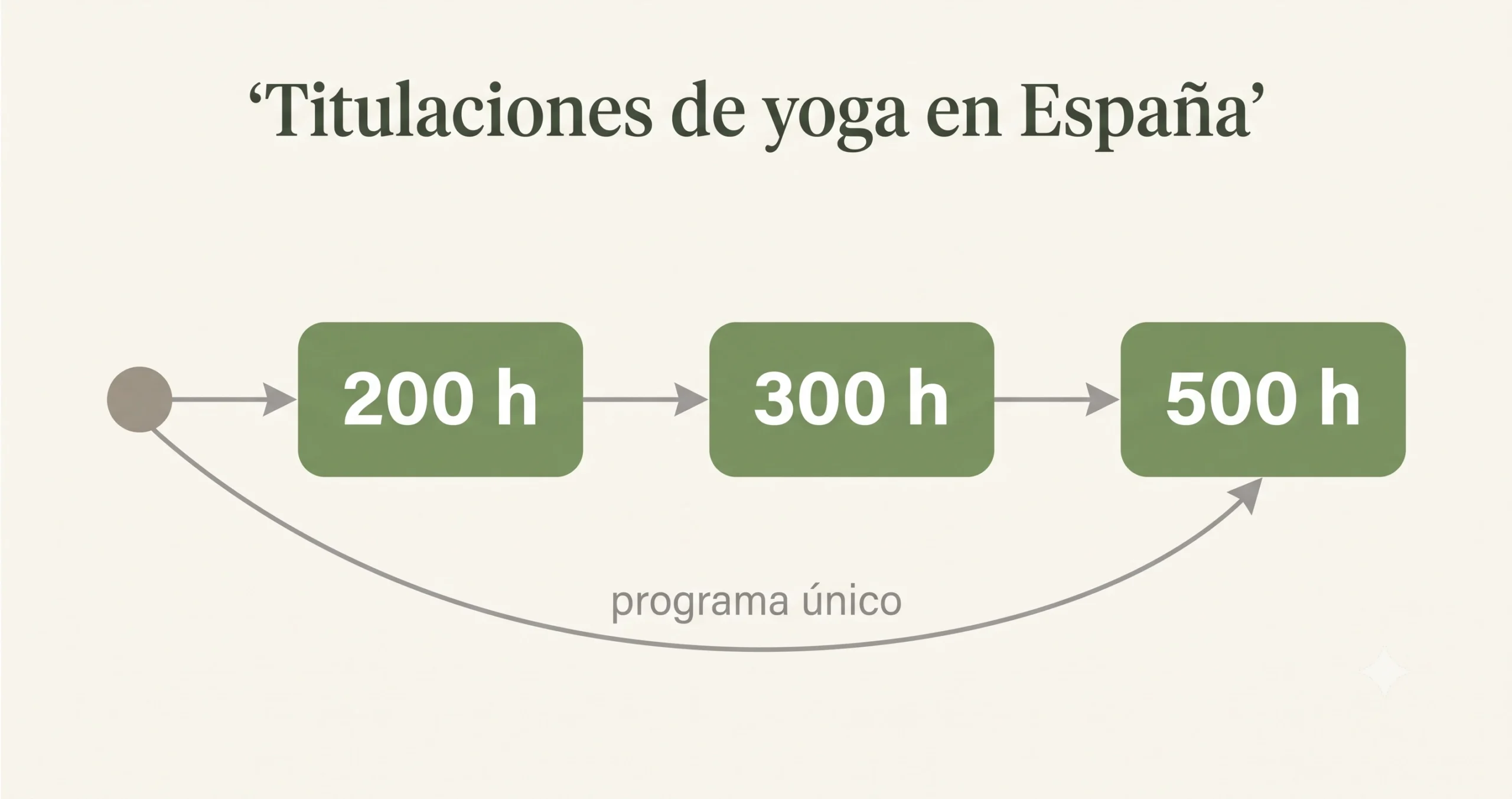
The RYT 500 credential can be obtained by completing a single 500-hour training at a school registered as an RYS 500, or by combining 200 hours at an RYS 200 with an additional 300 hours at the same school or at another school registered as an RYS 300.
The detail that is almost never explained, and that helps many people make their decision, is that when the training consists of two separate programmes, they can be taken at different schools, provided each school keeps its registered-school designation active.
In other words, you are not tied to the school where you completed the 200. You can take the 300 elsewhere, with a different approach or in another city, and combine the two. Before paying, however, it is worth checking that the second school’s registration is still active at that time.
The AFDA0311 professional certificate
This is the section missing from almost all the information available in Spanish, because that information is written by schools from outside Spain.
The AFDA0311 certifies competence to plan, lead and facilitate yoga instruction activities. Its training structure is defined by regulations: mastery of specific yoga techniques (180 hours), planning instruction activities (120 hours), methodology for instruction in sessions (150 hours), a first-aid module, and a 120-hour module of unpaid work-experience placements.
Compared with private training programmes, the difference is one of nature, not quality: here, the content is not decided by the school; it is set by regulations.
One point is worth keeping in mind: the requirements for professional practice are those established by the regulations and decrees of each autonomous community. There is no single answer for the whole of Spain, and if your aim is to work in the public or municipal sector, you need to ask your autonomous community.
How to check that a credential is what you think it is
Before paying for any training, spend ten minutes on this. It is the most worthwhile advice in the whole article.
Several different organisations have names that include the words “Yoga Alliance”, with additions such as “International”. They are separate entities, with their own registers and fees. Their existence does not make them illegitimate—each has its own model—but they are not the same organisation, and this is confirmed by both sides: Yoga Alliance is US-based and is not affiliated in any way with similarly named organisations operating internationally, while at least one of those organisations likewise states that it has never been affiliated with Yoga Alliance USA or any external body.
This matters for a practical reason: if a studio asks for “Yoga Alliance accreditation”, it normally means a specific one. Being registered with another is not the same for the purposes of that job offer.
How to check it in 10 minutes
- Ask the school for the exact full name of the organisation with which it is registered, and its website.
- Look up the school in that organisation’s public directory—in the case of Yoga Alliance, at yogaalliance.org. If it says it is accredited but does not appear there, that needs clarification.
- Check that the registration is currently active, not merely that it used to be.
- Remember that no private register is a licence. These registers are not government authorities and do not regulate who may legally teach yoga.
None of these questions is inappropriate. A serious school will answer them in an email.
So, which one do I need?
You want to teach classes at studios in Spain. Start with yoga teacher training of 200 hours: that is what the market asks for. Registration with an international organisation is an added visibility benefit, not a requirement.
You want to teach outside Spain or teach international students online. Here, brand recognition carries more weight, and the 200 → 300 → 500 route is the sector’s common language.
You want to work in the public, sports or municipal sector. The professional certificate is the key qualification. Check the specific requirements of your autonomous community before enrolling in anything.
You already have the 200 and are unsure whether to continue. The criterion is not the credential; it is whether your teaching is raising questions that your training does not answer. If it is not yet, invest in teaching more classes rather than in more training hours.
Last reviewed: August 2026.