Restorative yoga poses: 5 asanas with props
Restorative yoga poses are characterised by the use of props that allow the body to remain in them comfortably and with less muscular effort. Bolsters, blankets, blocks or even a wall help support different areas of the body while the pose is held.
That is why the same asana can feel very different when practised restoratively. The aim is not to go further or hold a position through strength, but to find an arrangement in which the body is genuinely supported.
Below, we will look at five common restorative yoga poses, how to set them up and what function the props serve in each one.
What makes a yoga pose restorative?
One of the most recognisable features of restorative yoga is the deliberate use of props. Instead of leaving an area of the body unsupported or asking the muscles to hold the entire position, items such as bolsters, blankets and blocks are used to fill those spaces and make the pose sustainable.
This means that the exact shape can vary from one person to another. Two practitioners may be doing the same restorative pose and need a different blanket height, another bolster angle or a slightly different position in relation to the wall.
The useful reference point is not whether the pose looks perfect from the outside, but whether the body is genuinely supported and you do not have to maintain unnecessary tension to remain in it.
What props are used in restorative yoga?
The most characteristic item is usually the bolster, a firm, elongated cushion that can support the torso, legs or pelvis.
Blankets are used both for cushioning and for adjusting small differences in height. Blocks allow certain areas to be raised more precisely, and a wall can take over some of the work that the legs would otherwise have to do.
You do not need to have every possible prop to understand the practice. What matters is understanding the function of each support: adapting the pose to the body, rather than forcing the body to adapt to a rigid shape.
5 restorative yoga poses
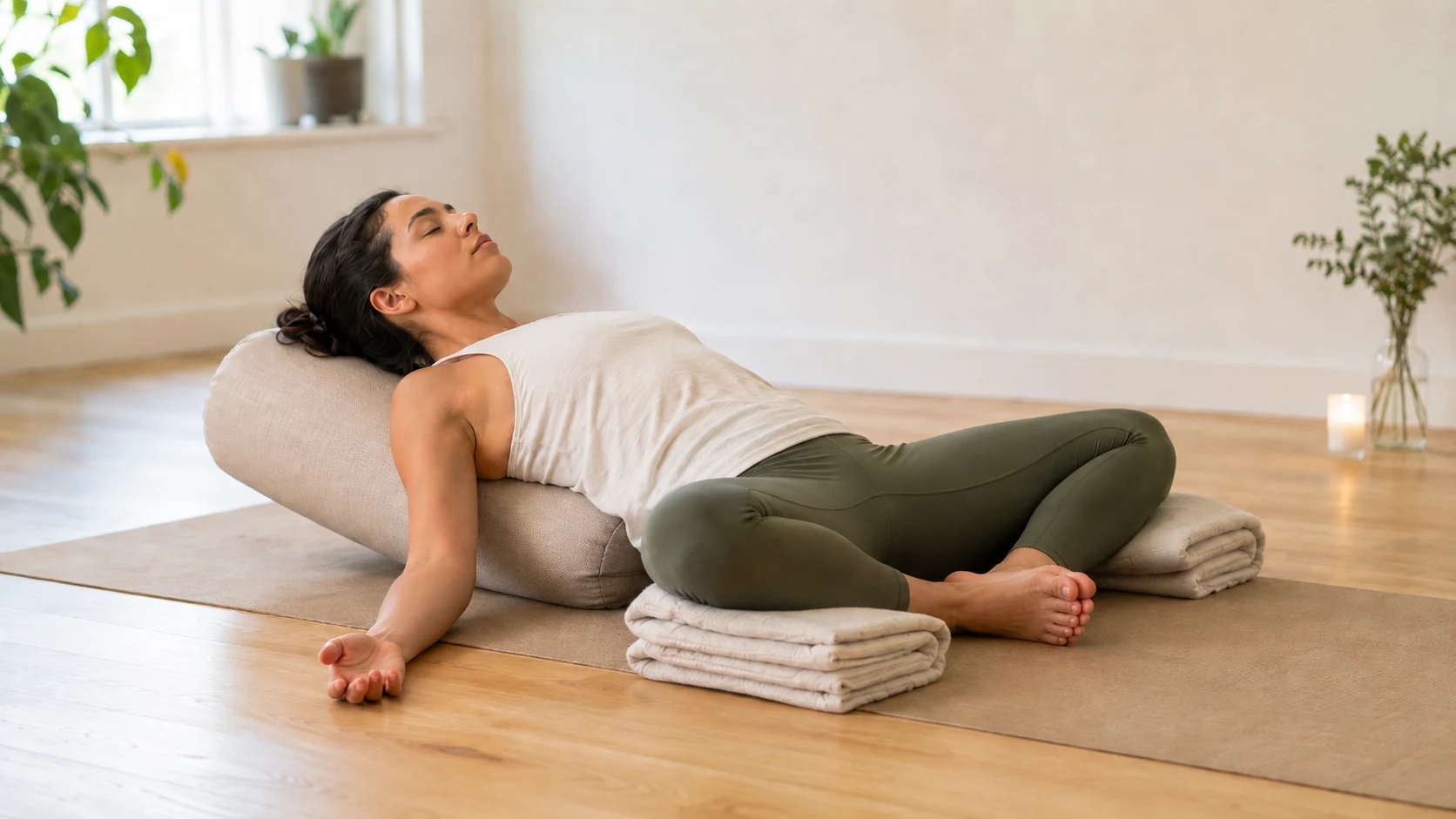
1. Supported Supta Baddha Konasana
Supta Baddha Konasana is a reclined pose in which the soles of the feet come together and the knees open out to the sides.
In a restorative version, the legs do not have to remain suspended in an effort to reach the floor. Blankets or supports can be placed beneath the outer thighs or knees so that both legs can rest at a comfortable height. The torso can also recline over a bolster.
Once the props are in place, the sensation should be very different from actively trying to increase hip opening. Here, we are not trying to force the knees down.
It is a good pose for understanding a basic rule of restorative yoga: if one part of the body is still working to remain in the air, it probably needs more support.
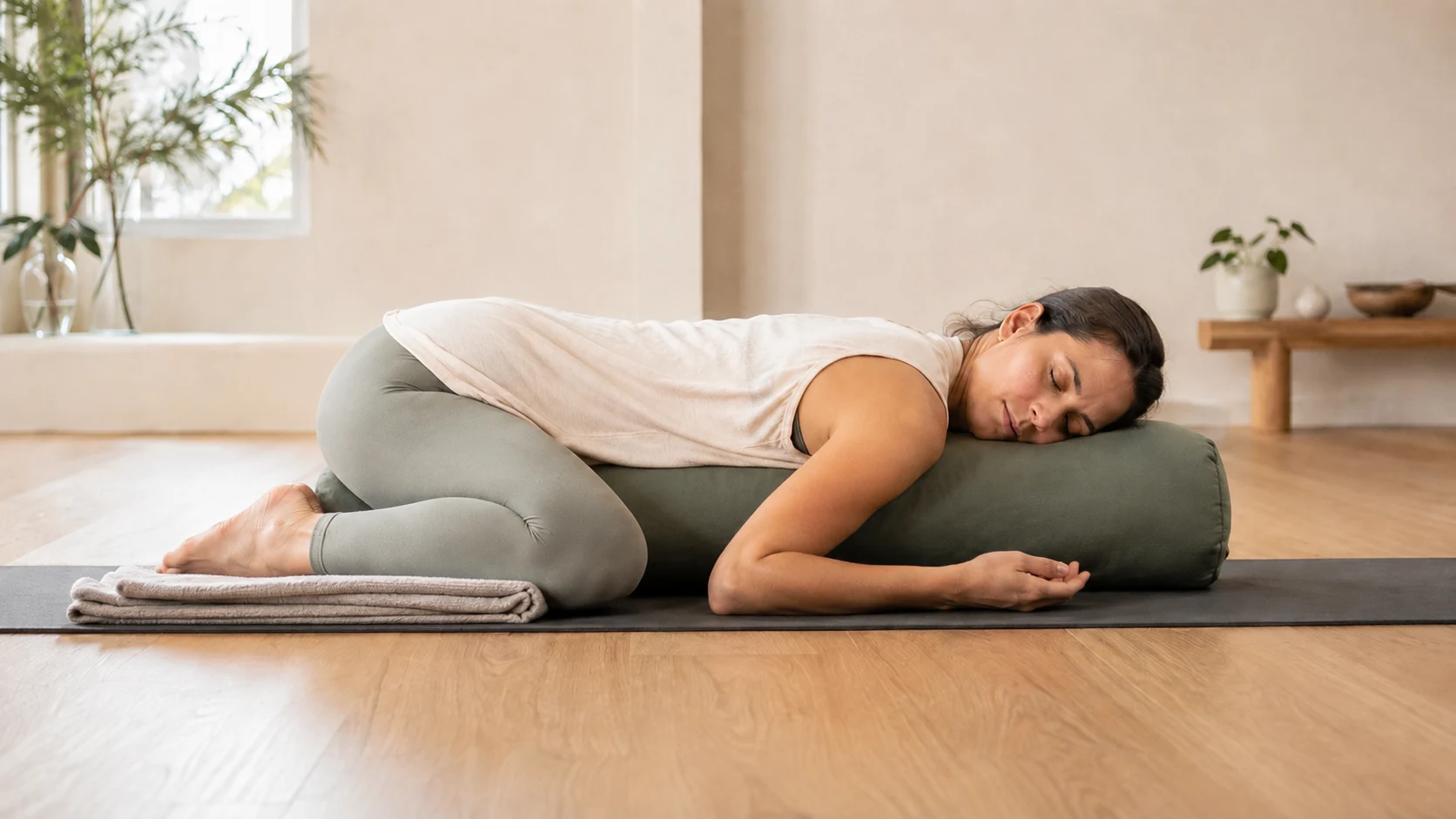
2. Restorative Balasana with a bolster
Child’s Pose, or Balasana, can also be transformed considerably when practised with props.
In a common setup, the knees are separated to leave room for a bolster to be placed lengthwise in front of the body. As you fold forwards, the chest and abdomen rest on it, and the head can turn to one side.
Blankets can also be used beneath the knees or around the legs when more height or cushioning is needed.
The difference from a conventional Balasana is precisely that the torso does not need to remain suspended.
If the bolster is too far away, the chest does not reach it comfortably or the knees are under too much pressure, the solution is not necessarily to try to lower yourself further. In a restorative practice, adjusting the props is part of the pose itself.
3. Viparita Karani: legs up the wall
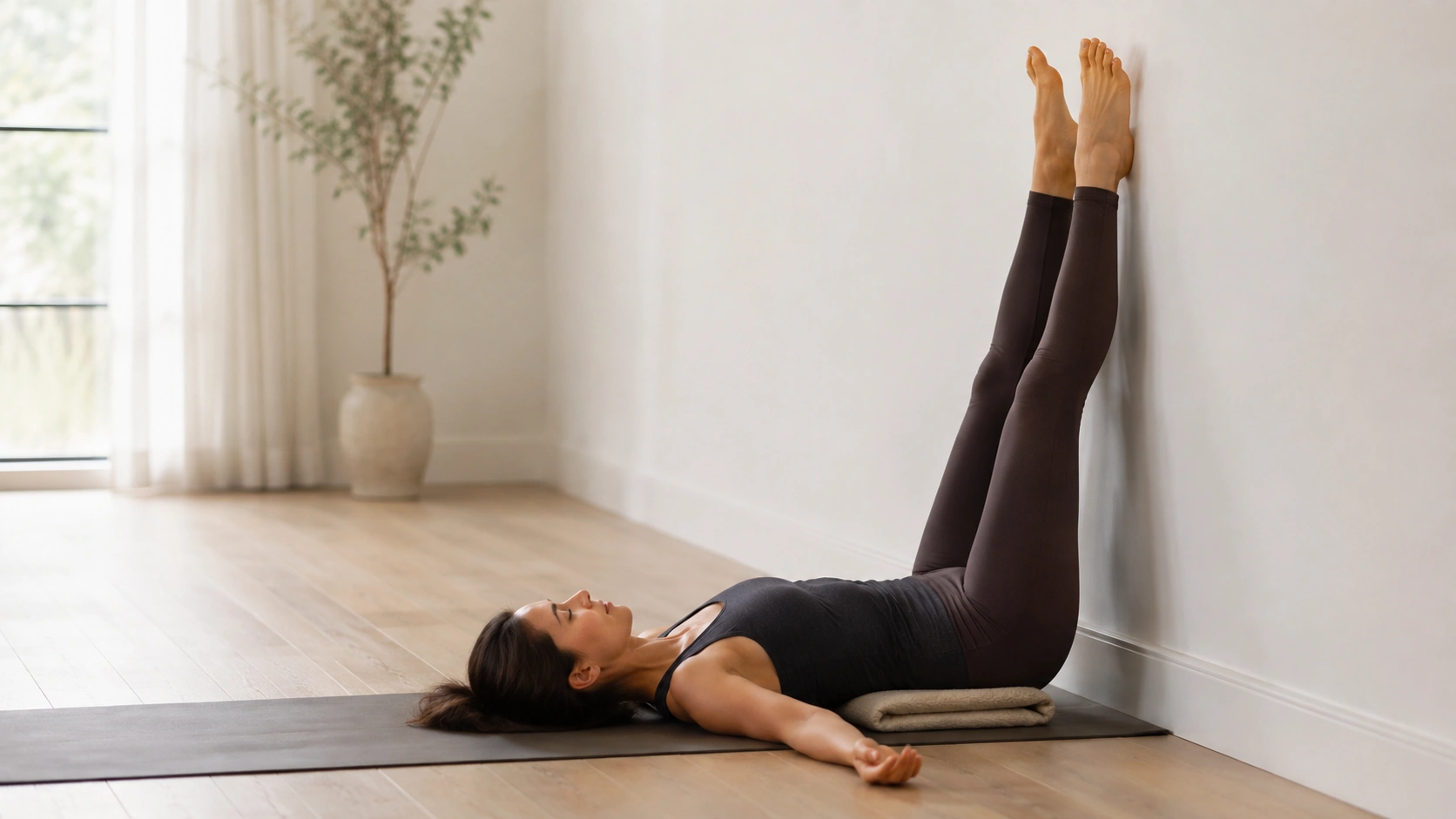
Viparita Karani, commonly known as legs up the wall, is one of the easiest restorative poses to recognise.
The torso remains lying down while the legs rest vertically against a wall. The distance between the pelvis and the wall can be adjusted for comfort, and blankets or other supports can also be added.
The pelvis does not have to be completely close to the wall. If that position requires you to keep the legs rigid or feels uncomfortable, moving slightly away can make the pose much more sustainable.
The arms can rest by the sides of the body, and the legs do not need to be actively extended. The wall is precisely what allows them to stop supporting themselves.
This pose clearly illustrates the logic of restorative yoga: the surroundings can also become a support.
4. Supported Setu Bandhasana
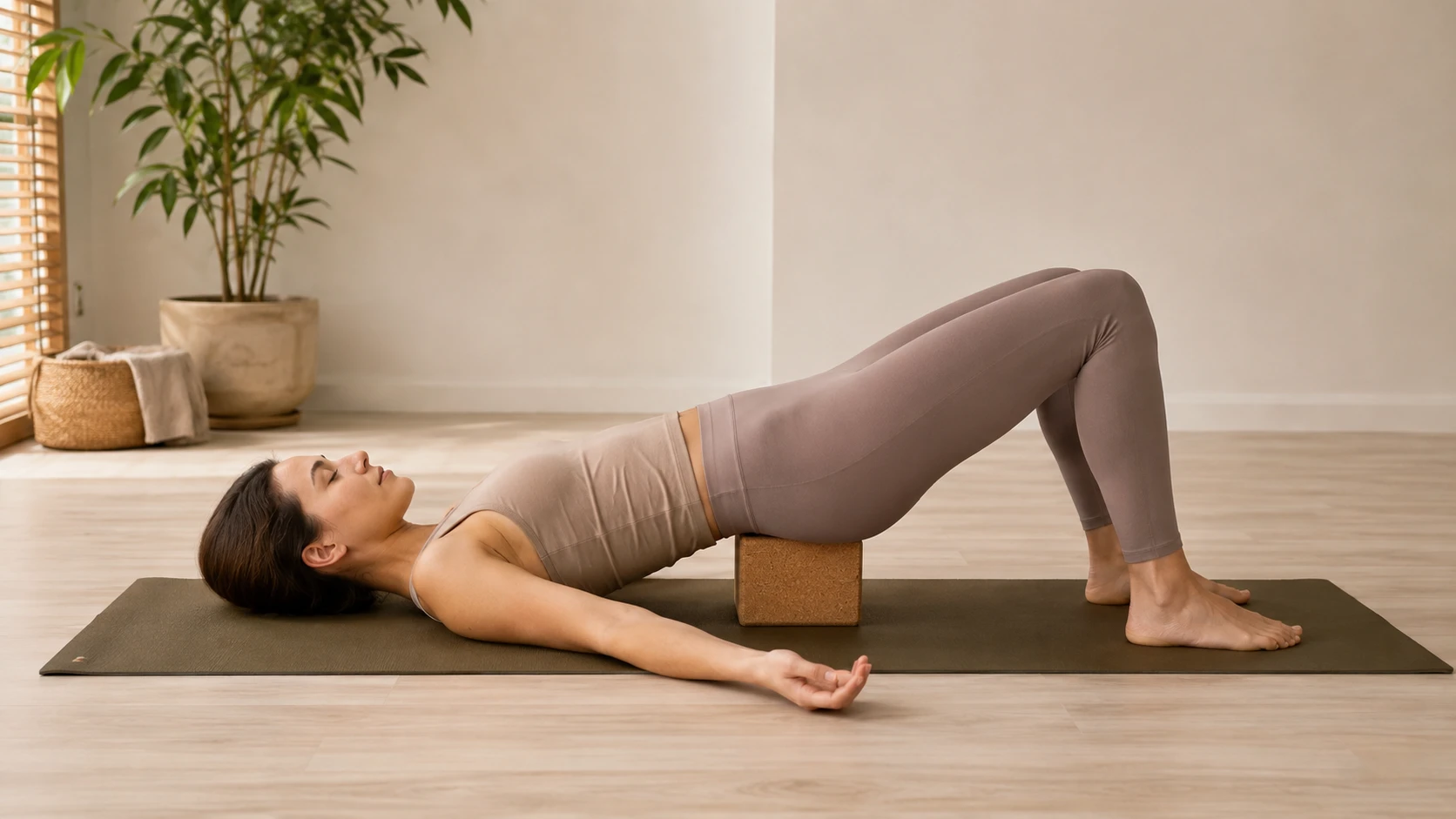
Supported Bridge Pose looks similar to the bridge pose found in other yoga classes, but it is held differently.
In a simple version, begin lying down with the knees bent and the feet grounded. Lift the pelvis only enough to place a block or support beneath the sacrum, then allow the weight to rest on it.
The important thing is not to turn it into an active bridge held by the strength of the legs and glutes. Once the support is in place, the intention changes: the prop supports much of the pose.
The height does not have to be maximal either. A higher block does not make the pose better. If the setup requires you to tense up to remain in it, it loses some of its restorative purpose.
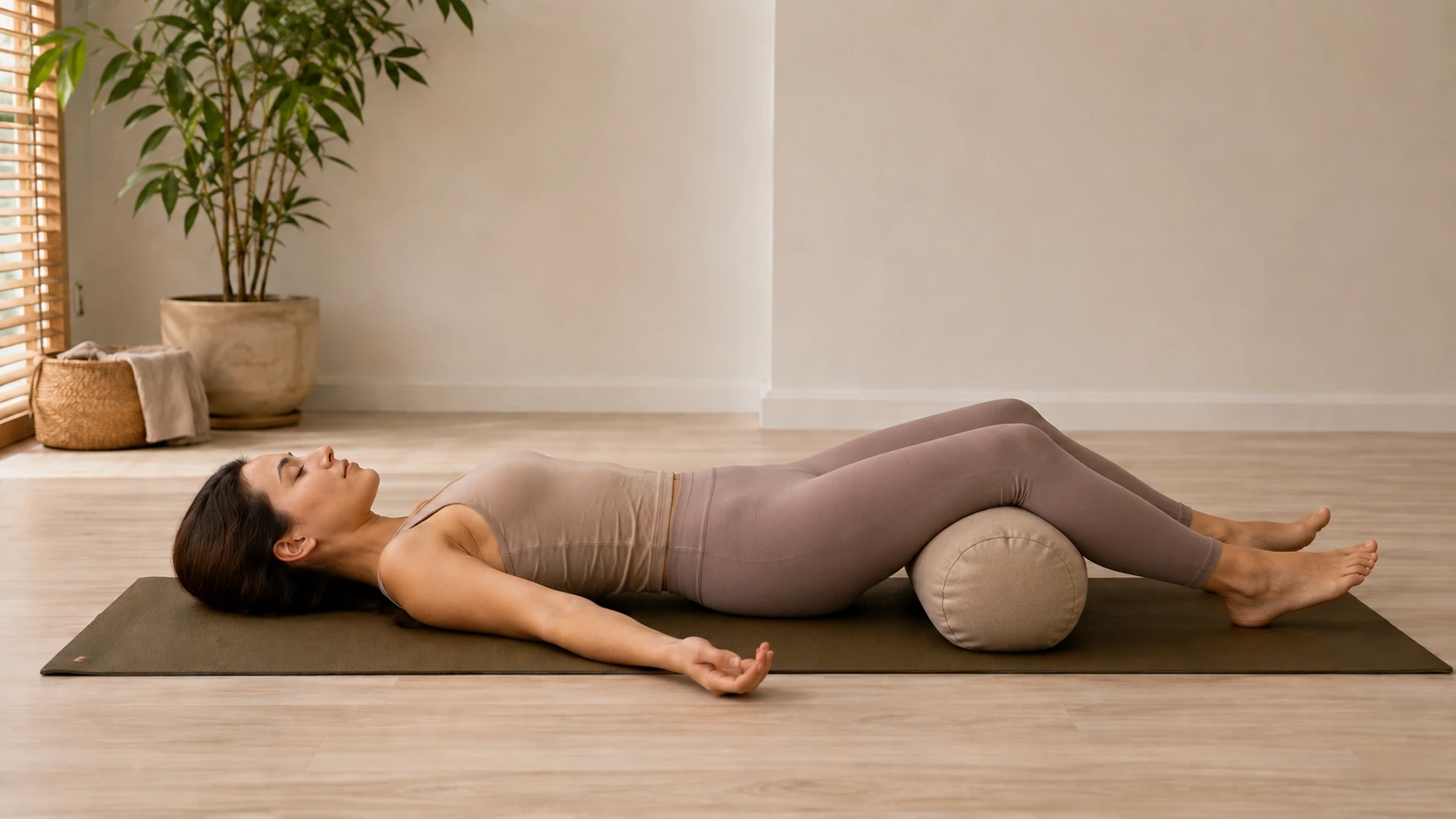
5. Savasana with support under the knees
Savasana often concludes many yoga practices, but it can also be set up specifically as a restorative pose.
One simple option is to lie on your back and place a bolster horizontally beneath the knees. With the legs slightly bent and supported, their weight can rest on the prop.
It may seem like the simplest pose of all, and that is precisely why it is useful for understanding the restorative approach.
There is no spectacular shape to achieve here. The question is much simpler: is any area still making an effort that could stop with a small change in support?
How long are restorative yoga poses held?
There is no single duration that should be applied to every pose.
One feature of restorative practice is that poses can be held for several minutes, but the length of time will depend on the pose, the props used and each person’s comfort.
If you are just starting, it makes more sense to learn to set up the pose correctly, check that you can breathe normally and observe whether you can genuinely remain there without struggling against the position.
Spending more time in an asana does not automatically make the practice better.
Are restorative yoga and Yin Yoga the same thing?
It is easy to confuse them because both can be practised slowly and a pose may be held for several minutes, but Yin Yoga and restorative yoga are not exactly the same.
In Yin, there may be an intentional stimulus while certain positions are held. In restorative yoga, by contrast, props play a central role in reducing effort and supporting the body more comfortably.
This explains why a visually similar pose may be approached in different ways.
It is not only which asana you are doing, but how you are practising it and what function the props serve.
Can restorative yoga poses be practised at home?
Many restorative yoga poses use simple equipment, and some, such as legs up the wall, require very little.
However, a photograph does not always show whether a particular setup suits your body. The height of the props, the distance from the wall or the position of the legs may need individual adjustments.
If you are just starting, a class can help you learn precisely that less visible part of the practice: how to modify a pose when your body does not fit comfortably into the initial setup.
And if a pose causes pain or a clearly uncomfortable sensation, there is no point in remaining in it simply because it is supposed to be held for several minutes.
What can you expect from a restorative yoga class?
A restorative yoga class may include far fewer poses than a dynamic class.
Some of the time is spent preparing the props, finding a position that genuinely works and then remaining there without needing to move quickly on to the next asana.
It is also normal to find more equipment around the mat: blankets, bolsters, blocks, straps or even a wall may form part of the practice.
If you are looking for continuous movement, the experience will probably be very different from a Vinyasa class. If, on the other hand, you want to explore a practice where the focus is on finding support and remaining in each pose, restorative yoga offers a different experience.
Would you like to try a restorative yoga class?
You can explore yoga studios on Yogagenda and browse the available options to find a practice that suits you.
Last reviewed: August 2026.