Breathing in yoga: how to breathe and 5 basic techniques
The breathing in yoga does not follow a single formula. In a quiet posture, it can be observed without changing it; in a dynamic sequence, it is usually coordinated with movement; and in a pranayama practice, it is consciously regulated through a specific technique.
Understanding this difference helps you practise with greater clarity. Breathing more deeply does not always mean breathing better, and holding the breath or forcing an exhalation is not a requirement when getting started.
In this guide, we will look at how to breathe during a class and at five basic exercises you can learn about without starting with intense techniques.
What is pranayama in yoga?
Pranayama is the conscious practice of breathing within yoga. The Common Yoga Protocol of the Ministry of Ayush of India describes it as developing awareness of the breath followed by the voluntary regulation of breathing.
This can include observing the passage of air, changing the length of the inhalation or exhalation, alternating the nostrils or introducing pauses. Breath retentions are known as kumbhaka, but they are not necessary for a first introduction and are best learnt under supervision.
Not every breathing instruction in a class is a complete pranayama practice. Saying ‘inhale as you raise your arms’ helps coordinate breathing and movement; a structured technique also has a position, a pattern and a purpose within the practice.
How to breathe during a yoga practice
Many classes suggest breathing through the nose, maintaining a continuous rhythm and avoiding letting exertion interrupt the breath. Even so, the specific guidance depends on the posture, the style and the individual.
- In opening or lifting movements, inhaling often feels natural.
- In forward bends and downward movements, an exhalation is often more suitable.
- In held postures, it is helpful to maintain a steady rhythm without unconsciously holding the breath.
- If a breathing pattern causes tension or dizziness, return to normal breathing.
The coordination can be seen clearly in sequences such as the step-by-step sun salutation. When you are learning, it is preferable to understand the movement first and add the breathing rhythm afterwards.
5 yoga breathing techniques
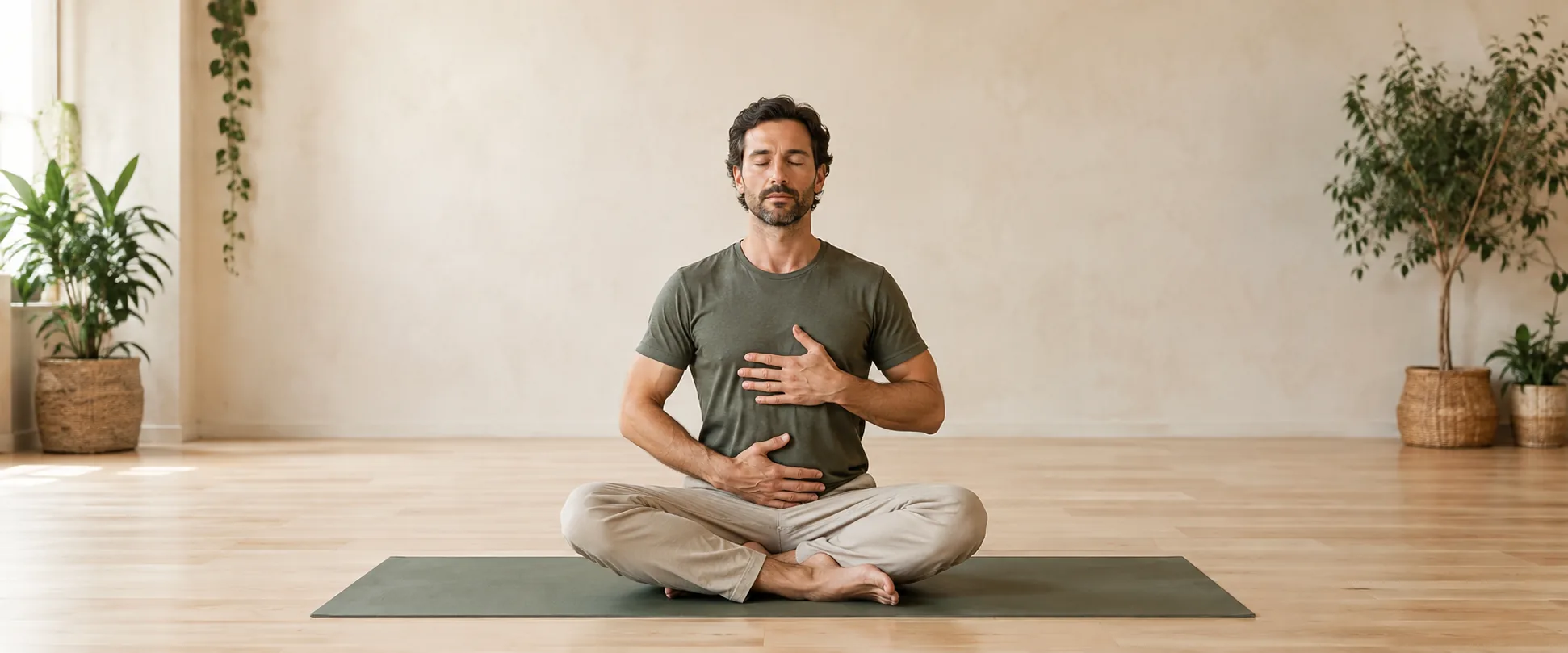
1 Observing the natural breath
This is the simplest starting point. You do not need to lengthen or correct the breath; simply notice how it comes in and goes out.
- Sit in a comfortable position or lie on your back.
- Let your abdomen and ribs move without exaggerating the movement.
- Notice where you feel the breath most clearly: the nostrils, chest or abdomen.
- Remain for a few minutes without trying to reach a specific number of cycles.
This exercise helps you notice whether you are clenching your jaw, raising your shoulders or holding your breath without realising it.
2. Three-part breathing
In some classes, students are taught to explore progressively the movement of the abdomen, ribs and upper chest. The aim is not to fill the lungs as much as possible, but to recognise how the breath can be distributed.
- Place one hand on your abdomen and the other on your ribs.
- Inhale gently and notice how the volume of your torso changes.
- Exhale without pushing or forcing the air out.
- Repeat at a comfortable rhythm and let your shoulders remain relaxed.
3. Sama Vritti or equal-duration breathing
Sama Vritti uses an inhalation and an exhalation of a similar duration. You can begin by silently counting to three as you breathe in and to three as you breathe out.
The count should suit you. If three counts feel too long, use two; if they are easy, you can try four. There is no need to add a retention between phases.
4. Nadi Shodhana without retention
Nadi Shodhana or alternate-nostril breathing moves the air between one nostril and the other. The Indian Government’s common yoga protocol includes a version without retention, which is suitable as an initial reference.
- Sit with a stable back and a relaxed face.
- Gently close the right nostril with your thumb and inhale through the left.
- Change the position of your fingers and exhale through the right.
- Inhale through the right, change sides and exhale through the left.
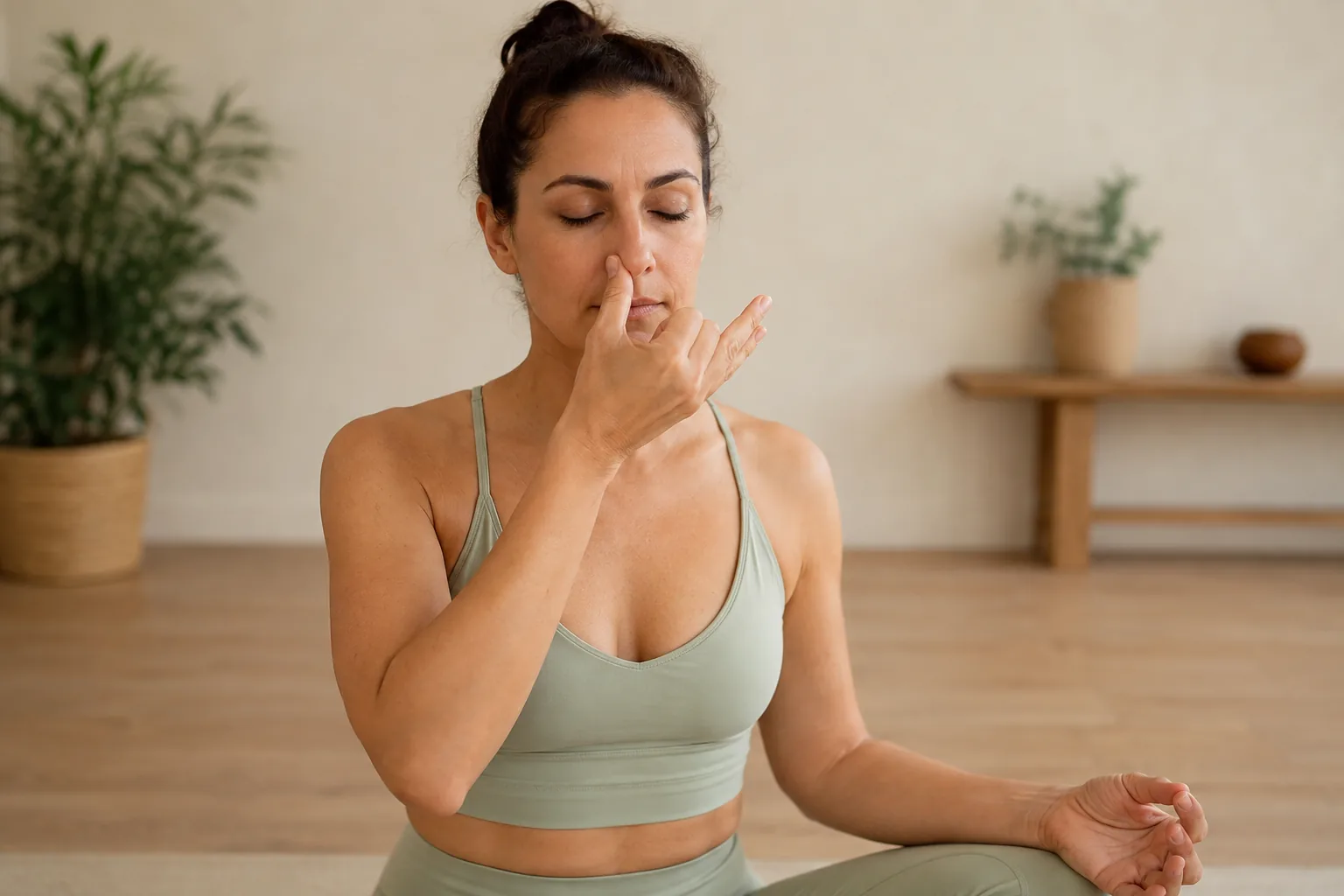
This completes one round. Practise without rushing and without holding your breath. If one nostril is blocked, do not force the air through.
5. Bhramari or bee breathing
Bhramari uses an exhalation with a gentle humming sound. The sound should feel comfortable and steady, without tightening the throat.
- Inhale through the nose.
- With your mouth closed and jaw relaxed, exhale while producing a continuous hum.
- Take a normal breath if you need to.
- Repeat just a few times at first.
Some versions add hand positions and the closing of the senses. These variations require a more precise explanation; the basic humming sound allows you to learn the mechanics without including them.
Where Ujjayi fits in
Ujjayi frequently appears in Vinyasa and Ashtanga practices. It creates slight resistance in the throat and a continuous sound that helps you maintain the rhythm. It does not involve breathing forcefully or making a harsh noise.
We cover it separately because it usually accompanies complete sequences rather than functioning as a short, standalone exercise. If you have never practised it, it is easy to tense the throat when trying to imitate the sound; in-person guidance can help you find a gentle version.
Common mistakes when working with the breath
Always trying to inhale as fully as possible
Comfortable breathing does not need to reach maximum capacity in every cycle. Forcing the volume can create more tension.
Lengthening the count too soon
The rhythm should allow you to complete the inhalation and exhalation without rushing at the end. Reduce the count if you need to catch your breath.
Practising breath retention without preparation
Voluntary pauses are part of specific techniques. Do not routinely add them to a beginners’ exercise.
Mistaking dizziness for progress
Dizziness, pressure or shortness of breath indicate that you should stop the technique and return to normal breathing.
Precautions and when to seek guidance
Gentle techniques without breath retention are usually the most prudent way to begin. Fast breathing, long retentions and intense closures merit individualised instruction.
If you are pregnant, have a respiratory or cardiovascular condition, uncontrolled blood pressure, a history of dizziness or any condition affecting your breathing, consult a healthcare professional and inform your teacher before practising specific techniques.
A class allows the posture, rhythm and duration to be adapted. You can search for yoga studios or browse workshops and events where breathing and meditation are practised.
Frequently asked questions
Do you always have to breathe through your nose?
Many techniques and classes use the nose, but this is not an absolute rule for everyone and every situation. If you cannot breathe comfortably, do not force a breathing pattern.
Is pranayama the same as deep breathing?
No. Pranayama comprises specific techniques for breath awareness and regulation. A single deep inhalation does not, on its own, define a pranayama practice.
How long should I practise?
A few minutes is enough to begin with. Consistency and comfort matter more than prolonging a session that has already lost its stability.
Can I use a mudra while breathing?
Yes, some techniques incorporate hand positions. Our guide to hand mudras explains several gestures and their differences.
Sources consulted
- Ministry of Ayush, Government of India — Common Yoga Protocol .
- Ministry of Ayush — Common Yoga Protocol, a brief guide featuring Nadi Shodhana and other techniques .
- Ministry of Ayush — Yoga Protocol for Adults .
- Journal of Ayurveda and Integrative Medicine — review of methodological problems in yoga and meditation research .
Would you like to learn how to breathe as part of a guided practice?
Explore yoga studios, activities from the workshop calendar and yoga retreats published on Yogagenda.
Last reviewed: September 2026 .