Savasana in yoga: what it is, how to do it and why it closes the practice
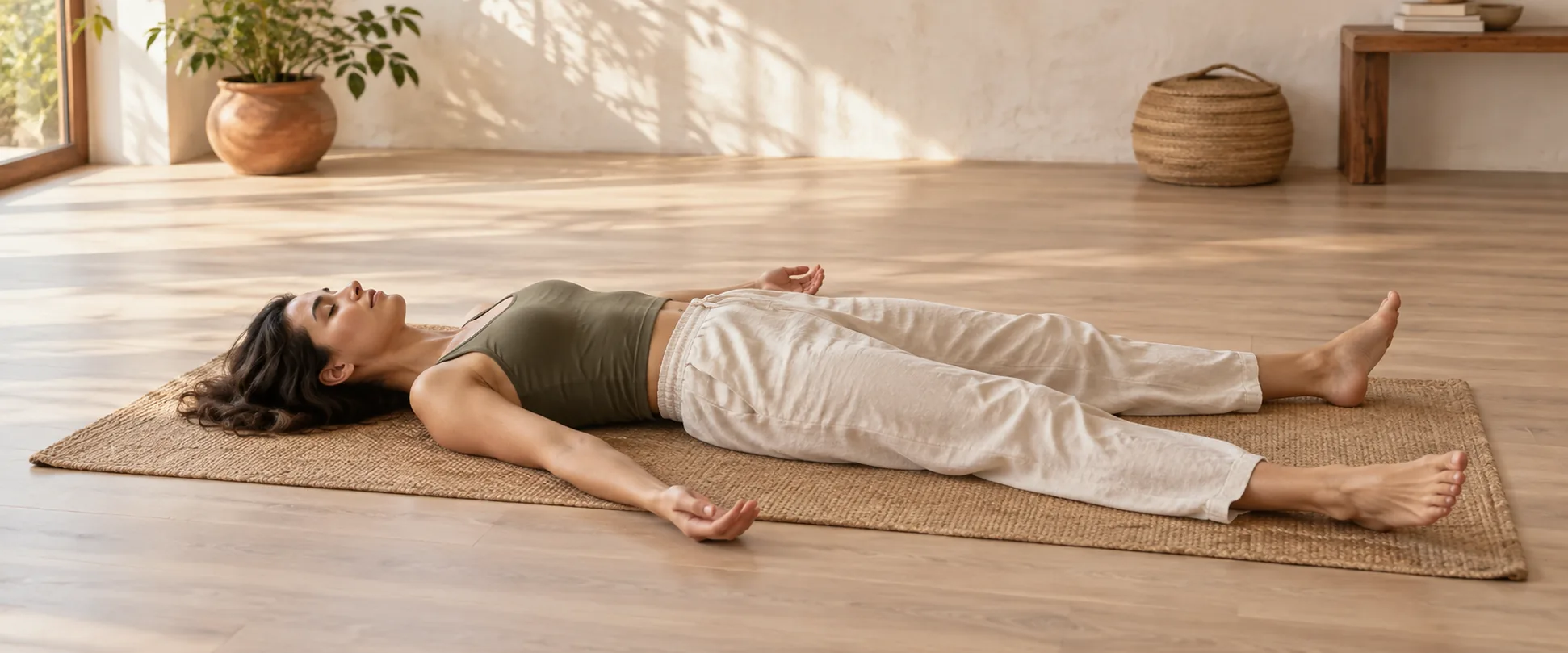
Savasana is the lying-down posture that usually closes a yoga class. From the outside it looks simple: the body rests on its back, the arms are held away from the body and the eyes are closed. However, remaining still without adding tension requires as much attention as a standing posture.
Its purpose within a session is not to «do nothing», but to allow voluntary effort to cease and observe how the body feels after the practice. In this guide, we will look at how to position yourself, how long to remain and which supports can make the posture more comfortable.
What is Savasana
The name comes from the Sanskrit śava, «corpse», and āsana, «posture» or «seat». This is why it is also known as corpse pose. The Common Yoga Protocol of the Ministry of Ayush includes it as a relaxation posture and describes a position on the back with the legs and arms apart, palms facing upwards and eyes closed.
Not all schools teach it in exactly the same way. The distance between the feet, the orientation of the head and the use of blankets or bolsters vary according to the person and the method. The useful reference point is a stable position in which you do not have to actively support any part of the body.
How to do Savasana step by step
- Sit on the mat and lower yourself to the floor in a controlled manner.
- Lie on your back and centre your head in line with your chest.
- Move your feet apart until your legs can rest without being held together.
- Move your arms a few centimetres away from your torso and turn your palms upwards.
- Let your fingers curl naturally and soften your jaw.
- Close your eyes if that feels comfortable and allow your breathing to find its rhythm.
You do not need to position your body with rigid symmetry. First correct obvious points of support —a turned head, a raised shoulder or a leg caught by clothing— and then reduce the corrections.
What to do during the posture
Savasana does not require you to control every breath. You can observe the contact between your body and the floor, mentally scan the areas that are still making an effort or listen to the teacher’s instructions. When a distraction arises, return to a simple reference point: the weight of your body or the natural movement of your breathing.
If you have just practised a sequence such as sun salutations, it is normal for your pulse and breathing to need some time to settle. Avoid turning this process into a test: you do not need to reach a special state for the posture to be part of the practice.
How long to remain in Savasana
There is no universal duration. In a short class it may take a few minutes; after a long practice, the teacher may set aside more time. To begin with, five minutes allow you to get to know the posture without turning the clock into a concern.
The useful duration is the length of time you can remain reasonably comfortable. If pain, intense numbness, a feeling of breathlessness or increasing restlessness appears, modify the position or leave it calmly.
Adaptations and supports
A bolster under the knees
Bending the legs slightly and resting the knees on a bolster can reduce tightness in the backs of the legs or the lower back. The support should hold both legs equally.
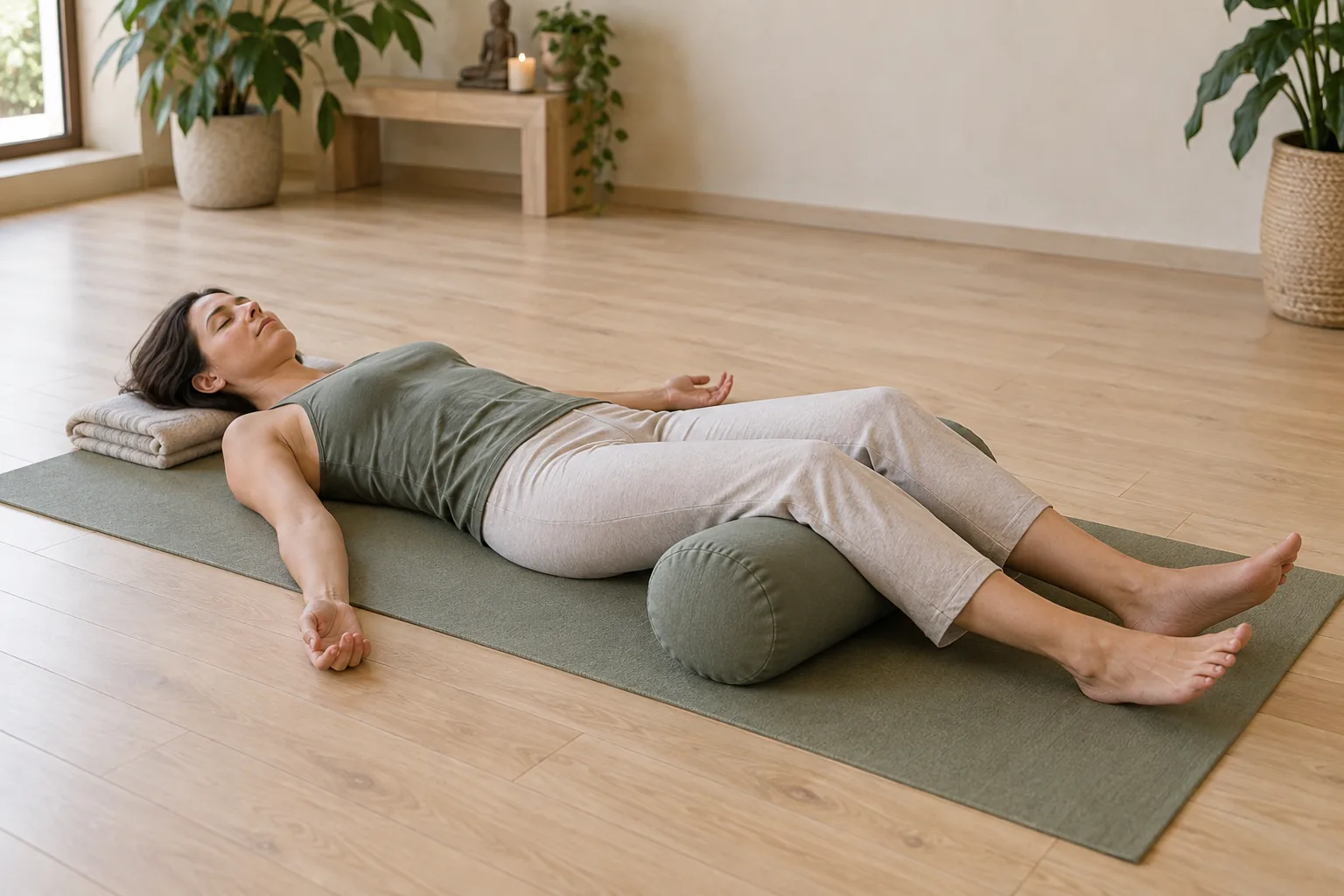
A thin blanket under the head
If your chin is clearly higher than your forehead or you notice tension in the nape of your neck, try a thin, neatly folded blanket. Support that is too high can excessively close the front of the neck.
Legs on a chair
Another option is to place your calves on the seat of a stable chair, with your knees approximately over your hips. This variation changes the position considerably, so it is best to prepare it before lying down.
Side-lying rest
When lying on your back is not appropriate, you can use a side-lying position with support for your head and, if necessary, between your knees. During pregnancy or in other particular circumstances, consult the appropriate professional about the adaptation and inform the teacher.
Common mistakes
Keeping the legs active
If you try to keep your feet perfectly upright, the muscles continue working. Let your legs rotate naturally as long as your knees and hips are comfortable.
Holding the arms against the body
Moving them slightly away allows the shoulders to rest. Adjust the distance so that the joint is not compressed.
Forcing deep breathing
At the end of a session, your breathing may change on its own. If you want to learn specific techniques, consult the guide to breathing in yoga and pranayama; in Savasana, simply observing it is usually enough.
Getting up suddenly
To come out of the posture, slowly move your hands and feet, bend your legs, turn on to one side and use your arms to sit up. Spend a few seconds sitting before standing.
Why it usually closes a yoga class
Many sequences move from broad movements and active postures towards more stable positions. Savasana marks the end of this journey. The common protocol of the Government of India also places relaxation practices at the end of its sequence, after the asanas.
The posture is used in very different methods, from dynamic classes to restorative yoga. This does not mean that it serves the same purpose or has the same duration in all of them. The context and sequence matter.
Precautions
The National Center for Complementary and Integrative Health considers yoga generally safe when practised appropriately, but reminds us that injuries can occur and that some people need modifications.
If lying on your back makes breathing difficult, increases pain, causes dizziness or is not advisable because of a particular condition, do not remain in the posture out of obligation. Ask the teacher for an alternative and consult a healthcare professional when necessary.
Frequently asked questions
Is Savasana a meditation?
It can include attention and observation, but not every Savasana practice is a formal meditation. It depends on the instructions and the class setting.
Do you have to fall asleep?
No. You may fall asleep, especially if you are tired, but the usual intention is to rest while maintaining some degree of awareness.
Can I skip Savasana?
You can adapt any practice to your circumstances, although it is best not to treat the closing section as wasted time. If you need to leave early, tell the teacher and do a brief version without interrupting the group.
What should I do if my lower back hurts?
Try bending your knees or placing support under them. If the pain continues or is intense, leave the posture and ask for an individual adaptation.
Sources consulted
- Ministry of Ayush, Government of India — Common Yoga Protocol.
- Ministry of Ayush — Common Yoga Protocol Guidelines.
- NCCIH — Yoga: Effectiveness and Safety.
- SOAS University of London — Hatha Yoga Project, academic context on the dynamic history of physical yoga.
Would you like to learn Savasana as part of a complete practice?
You can explore yoga studios, browse workshops and events or discover yoga retreats published on Yogagenda.
Last reviewed: September 2026.