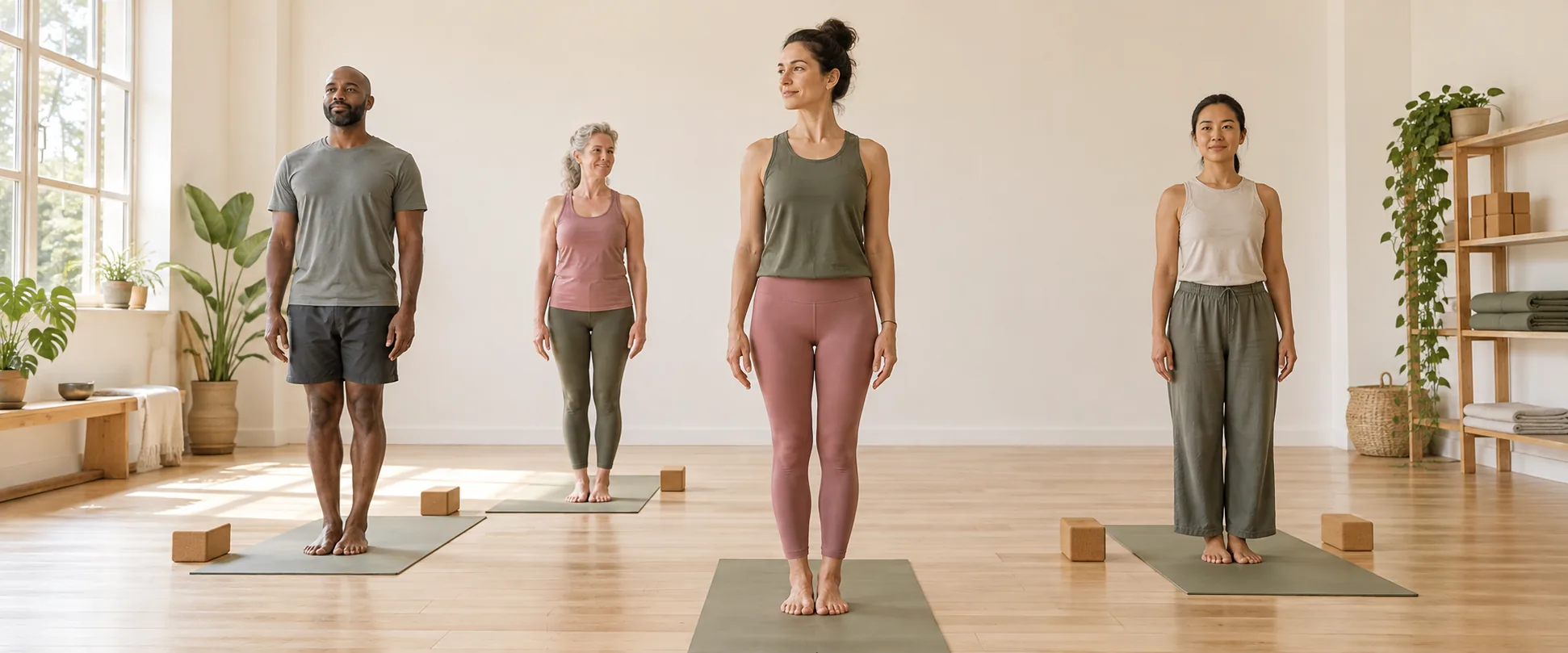
Yoga for beginners: how to start from scratch without feeling lost
Starting yoga does not require you to be flexible, know the Sanskrit names or buy everything from a specialist shop. The first step is to choose a practice suited to your starting point, learn a few key references and give yourself time to discover how your body responds.
This beginner’s yoga guide explains what happens in a first class, how to choose a style and teacher, which postures you will recognise and how to start from scratch without turning your practice into a race.
What you need to know before starting yoga
Contemporary yoga brings together many different approaches. Some classes link postures continuously; others work on alignment and the use of supports at a slower pace; there are also gentle, restorative, breathing and meditative practices. Two sessions with the word ‘yoga’ in the title can feel very different.
The NCCIH describes modern yoga as a practice that normally combines postures, breathing techniques and meditation, while noting that there are many styles and that this diversity makes it difficult to generalise about results. To begin, look for a class explicitly labelled as an introduction, basic level or beginners’ class.
Which style might suit you
- Hatha: is often used for moderately paced classes, although the content varies from one centre to another.
- Vinyasa: links movement and breathing; it can be accessible or intense depending on the level.
- Iyengar: progressively works on alignment, staying in postures and the use of supports.
- Restorative: uses supports to hold postures for longer and reduce active effort.
- Kundalini: may combine postures, breathing, chanting and meditation in set sequences.
No label guarantees a particular intensity on its own. Ask the centre what previous experience the session requires, whether the teacher offers adaptations and how much of the class involves movement. Our comparison of Hatha and Vinyasa may help you understand two common approaches.
What happens in a first class
You will usually begin with a brief settling-in or warm-up, move on to a sequence of postures and finish with a quiet phase. The order, music, use of Sanskrit words and instructions vary between schools.
Arrive a few minutes early and tell the teacher if it is your first time, if there are movements you should avoid or if you have an injury or relevant health condition. You do not need to justify taking a rest. In a well-structured class, stopping, using a support or choosing a variation is part of the practice.
6 basic postures you will recognise
Tadasana or Mountain Pose
This is a standing position in which you learn to distribute your weight and organise your posture. It looks simple, but introduces references that recur in many asanas.
Balasana or Child’s Pose
It is often used as a transition or resting position. It can be modified with blankets, blocks or a wider distance between the knees.
Adho Mukha Svanasana or Downward-Facing Dog
You support yourself on your hands and feet and lift your pelvis. You do not need to straighten your legs completely: bending the knees can help you lengthen your back.
Bhujangasana or Cobra Pose
This is a prone backbend in which the chest lifts. Height matters less than distributing the movement without compressing the lower back.
Virabhadrasana II or Warrior II
A standing posture with the legs apart and arms extended. You will learn to align your feet, knee and pelvis without seeking maximum depth.
Savasana
The lying-down posture that usually closes the session. Our step-by-step Savasana guide explains its positioning and supports.
How breathing works in yoga
In many classes, the inhale is coordinated with opening or lifting movements and the exhale with forward bends or lowering. This is guidance, not a test you have to pass from your first day.
If you lose the rhythm, return to natural breathing. Specific techniques belong to pranayama and are best learnt in stages; you can explore this topic further in our guide to breathing in yoga.
Practising at home or attending a class
A short home practice helps you repeat what you have learnt, while a class provides observation, sequencing and adaptations. The NCCIH recommends that beginners avoid extreme practices and learn with the guidance of a qualified instructor.
If you practise at home, use a short sequence you already know. The step-by-step Sun Salutation can serve as a reference once a teacher has shown you its transitions, but you do not need to master it to attend a class.
What equipment do you really need
For a first session, comfortable clothing and a mat are usually enough. Many studios lend equipment; check before buying. Blocks, a strap and a blanket expand your support options, but they are not signs of an advanced level.
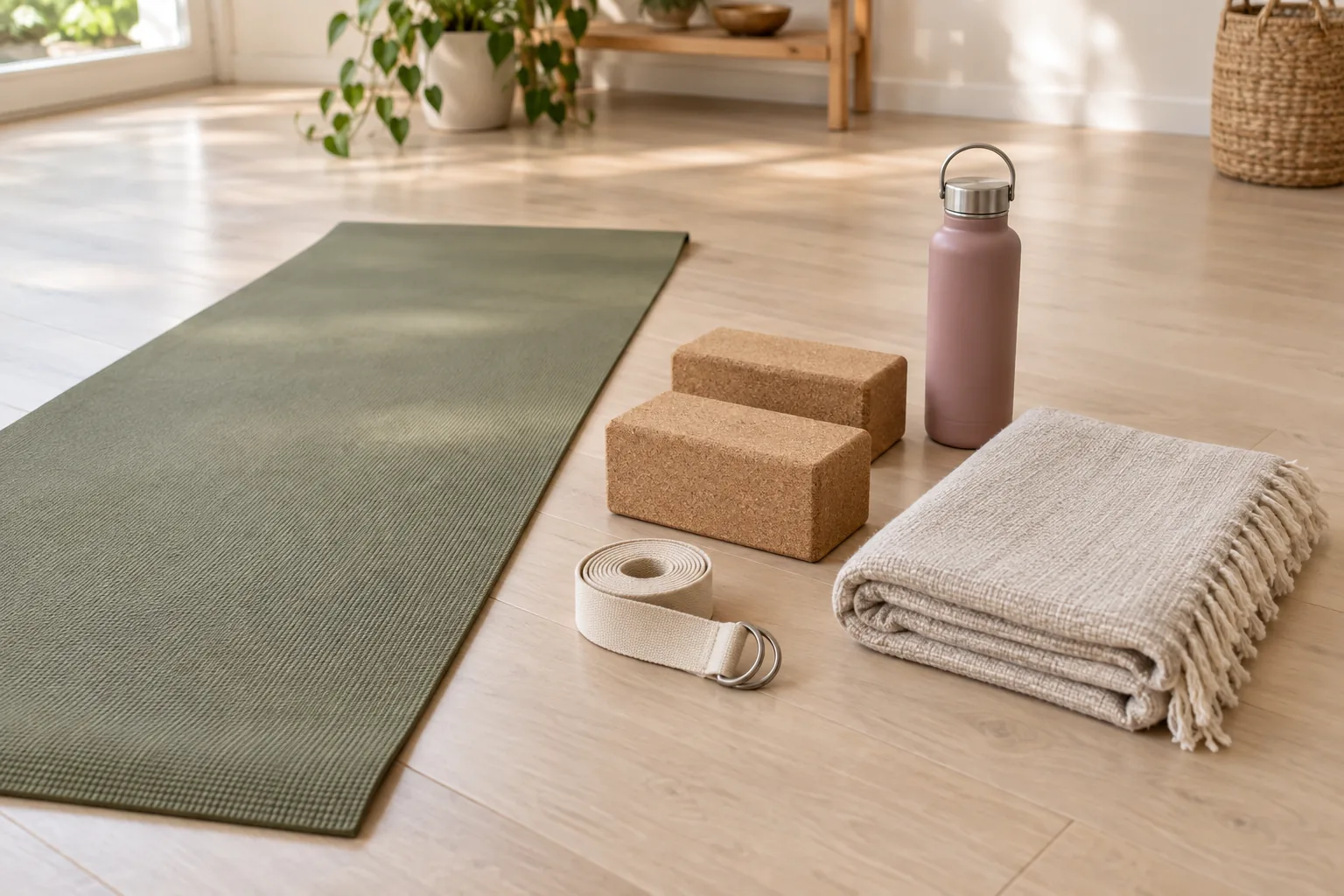
The Iyengar Yoga UK association explains that blocks, belts, bolsters, chairs and blankets allow postures to be adapted to different bodies and levels of experience. A support is not a way of ‘cheating’, but a way of changing the conditions of the posture.
Common mistakes when starting
- Comparing yourself with other people: outward appearance does not show each body’s experience, injuries or effort.
- Choosing a class that is too intense: ask about the level before booking.
- Ignoring sharp pain or dizziness: stop and explain what is happening.
- Practising only what you can already do: progress includes exploring simple variations and resting.
- Expecting immediate results: a sustainable practice is built through repetition, not a perfect first session.
How to establish a regular practice
Choose a frequency you can maintain. One class a week and a few minutes of repetition at home may be a more realistic start than a daily plan you will soon abandon. Note down any questions that arise and take them to the next session.
Your surroundings matter too. A nearby studio, a suitable timetable and a teacher whose language you understand may have more influence than choosing the ‘ideal’ style on paper. You can search for yoga studios and compare their listings before getting in touch.
Frequently asked questions
Do I have to be flexible to do yoga?
No. Mobility varies between people and is not an entry requirement. A beginners’ class should offer alternatives and teach you to work within your available range.
How many days a week should I practise?
There is no universal number. Start with a frequency that fits your life and increase it only if you recover well and remain interested.
Can I eat before a class?
Avoid a large meal immediately before moving. If you need to eat, leave a reasonable gap and ask the centre for its recommendations.
What should I do if I have an injury?
Consult the healthcare professional responsible for your care and tell the teacher before the session. A general class is not a substitute for individual assessment.
Sources consulted
- NCCIH — Yoga: Effectiveness and Safety.
- NCCIH — Yoga for Health, a guide to safety and starting practice.
- Ministry of Ayush — Common Yoga Protocol.
- Iyengar Yoga UK — Beginner’s Iyengar Yoga.
Looking for somewhere to start?
Explore yoga studios, upcoming workshops and events and retreats to compare options and contact organisers directly.
Last reviewed: September 2026.